Sleep & Space
Waking Up at 3am? What Your Body and Your Bedroom Are Telling You
Dr S Pujah · 25 September 2026
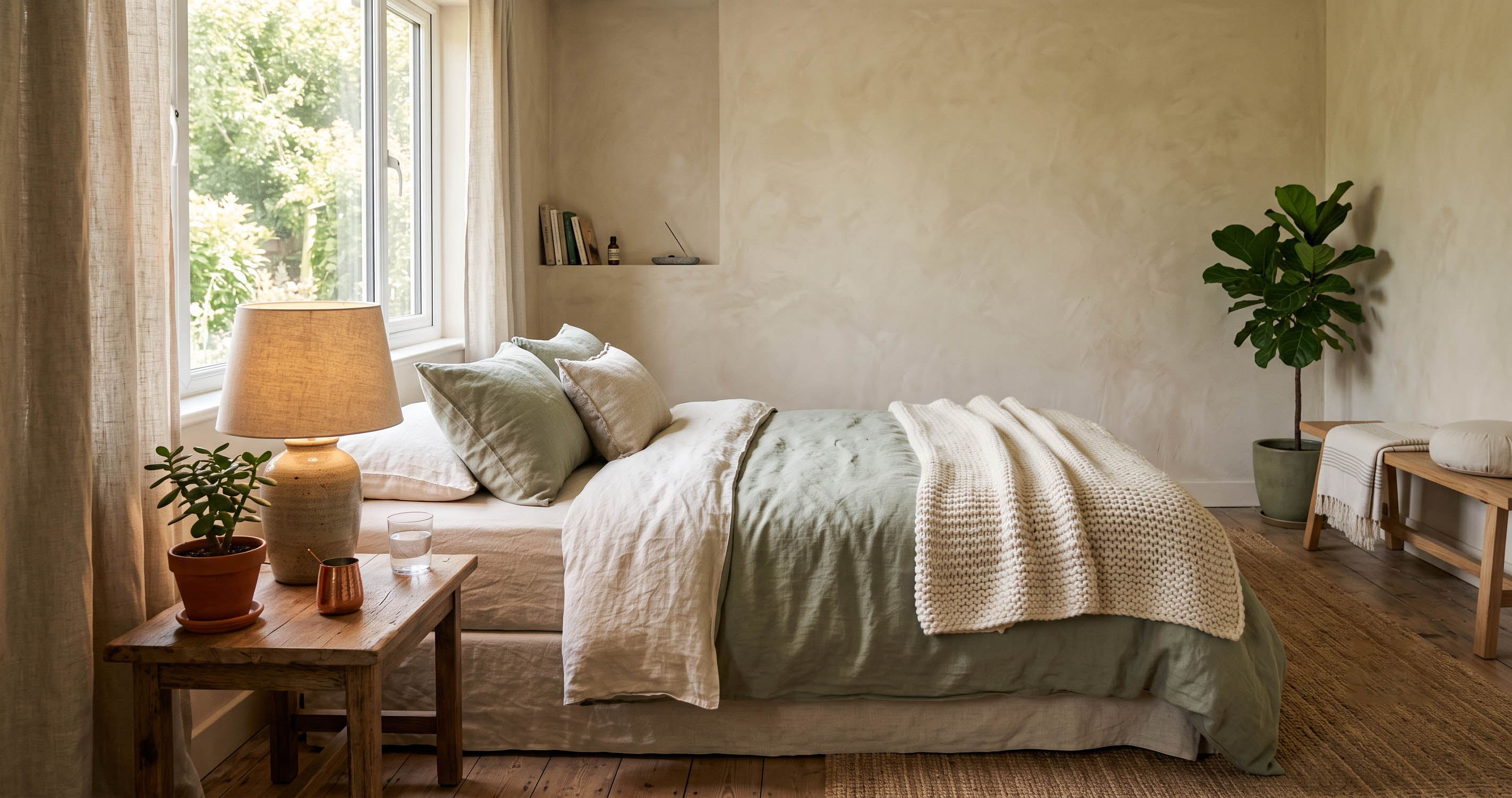
Waking up at 3am usually has ordinary causes you can look at: a late or heavy dinner, screens and bright light in the evening, a room that is too warm, too bright or too noisy, and a mind still holding the day. Ayurveda calls 2am to 6am the vata hours — light, mobile and easily stirred — so small disturbances show up then.
If this is your pattern, you are far from alone. The good news is that most of what you can change sits in two places you control completely: how you spend the last three hours of your evening, and the room you sleep in.
Why 3am? The Ayurvedic daily clock
Ayurveda divides the 24-hour day into periods, each linked to one of the three doshas:
- 6am to 10am and 6pm to 10pm: kapha — steady, heavy, slow.
- 10am to 2pm and 10pm to 2am: pitta — warm, active, digestive.
- 2am to 6am and 2pm to 6pm: vata — light, airy, quick-moving.
In this view, the hours before 10pm carry a natural heaviness that makes it easier to fall asleep. From 10pm to 2am the body turns its attention to digesting the day — both the food and the experiences. From 2am the quality of the night becomes lighter and more mobile, and anything unsettled has an easier time surfacing.
That is why many people who fall asleep easily still find themselves awake around 3am: the lightness of the vata hours meets whatever the evening left unfinished. The same tradition calls the period roughly an hour and a half before sunrise brahma muhurta, the most settled time for quiet practice. The goal is to reach it rested, not to arrive at it at 3am with a racing list.
What your evening may be telling you
Late, heavy dinners. A large meal after 9pm keeps digestion busy through the pitta hours. Try eating your main meal at midday and a lighter, warm dinner at least three hours before bed.
Caffeine after lunch. Coffee, strong tea and many soft drinks can stay with you well into the night. Move your last cup to before 2pm for two weeks and notice any difference.
Screens in bed. Bright light and fast-moving content keep the mind in daytime mode. Set a screen cut-off an hour before sleep and keep the phone charging outside the bedroom.
An unfinished day. If you go to bed with open loops — an unanswered message, a decision you have not made — they often reappear in the small hours. Spend five minutes before bed writing down tomorrow's first three tasks. Written down, they stop asking to be remembered.
Irregular timings. Going to bed at 10pm one night and 1am the next keeps the rhythm unsettled. A consistent bedtime, even at weekends, is one of the simplest changes you can make.
What your bedroom may be telling you
The bedroom is the part people most often overlook, and it is where the Geo 7 approach to space begins. Walk into your bedroom tonight and check these one at a time.
Light. Stand in the room with the lights off after dark. Can you see the street lamp through the curtains? The standby light on the TV? The glow of a charger? Even small points of light can be enough to lift you out of deep rest. Blackout curtains and covering standby lights cost very little.
Temperature and air. In Dubai, Doha and Riyadh, air conditioning often cycles on and off through the night, and the room can swing from cold to stuffy. Set a steady temperature, make sure the unit is not blowing directly onto the bed, and open a window briefly before bed if the air feels stale.
Sound. A compressor clicking on, a lift, a neighbour's door. If you cannot remove the source, a steady background sound such as a fan can soften sudden noises.
The clock. If you can see the time from your pillow, you will check it at 3am, and the checking itself keeps you awake. Turn the clock away.
Clutter and electronics. A bedroom that doubles as office, storage and gym keeps sending the mind reminders of unfinished work. Clear the space under the bed, move the laptop out, and keep only what belongs to rest.
Vastu for a more settled bedroom
- Head direction. Sleeping with the head towards the south or east is traditionally preferred; sleeping with the head to the north is avoided.
- Bed placement. Place the bed against a solid wall rather than under a window, with space to walk on both sides.
- Mirrors. Avoid a mirror that reflects the bed. If a wardrobe mirror faces you, cover it at night.
- Room position. The south-west of the home is traditionally the preferred zone for the main bedroom, as it is associated with stability.
- Beams. Avoid sleeping directly beneath an exposed beam or heavy overhead shelf.
You do not need to renovate to apply these. Turning the bed, moving a mirror or clearing a corner are all small, reversible changes you can test over two or three weeks.
If you are awake at 3am tonight
Resist the urge to pick up the phone. Keep the lights low, and try slow breathing: breathe in gently through the nose for a count of four, and out for a count of six, for a few minutes. If your mind is busy, write the thought on a notepad by the bed and let it go until morning. If you are still awake after twenty minutes or so, get up, sit somewhere dim and quiet, and return to bed when you feel sleepy.
Questions people ask
Why do I wake up at 3am every night?
There is rarely one cause. Common everyday factors include late meals, caffeine after lunch, evening screens, a warm or bright room and an unsettled mind. Ayurveda notes that 2am to 6am is the light, mobile vata period, when small disturbances are more easily felt.
What does Ayurveda say about waking up at 3am?
Ayurveda links the hours from 2am to 6am with vata. Its general guidance is a regular routine, an earlier and lighter dinner, a calm evening, and a warm, quiet, dark room to sleep in.
Can my bedroom layout affect how well I sleep?
Many people notice a difference when they reduce light and noise, steady the temperature, and remove work and clutter from the bedroom. Vastu adds specific guidance on head direction, bed placement and mirrors that you can test for yourself.
Your next step
If you want a complete, room-by-room way to set up your home for rest and focus, the Geo 7 Spaces Method book walks you through it step by step.