Books
The Aromatherapy Chakra Petal Guide: One Oil per Chakra
Dr S Pujah · 26 November 2026
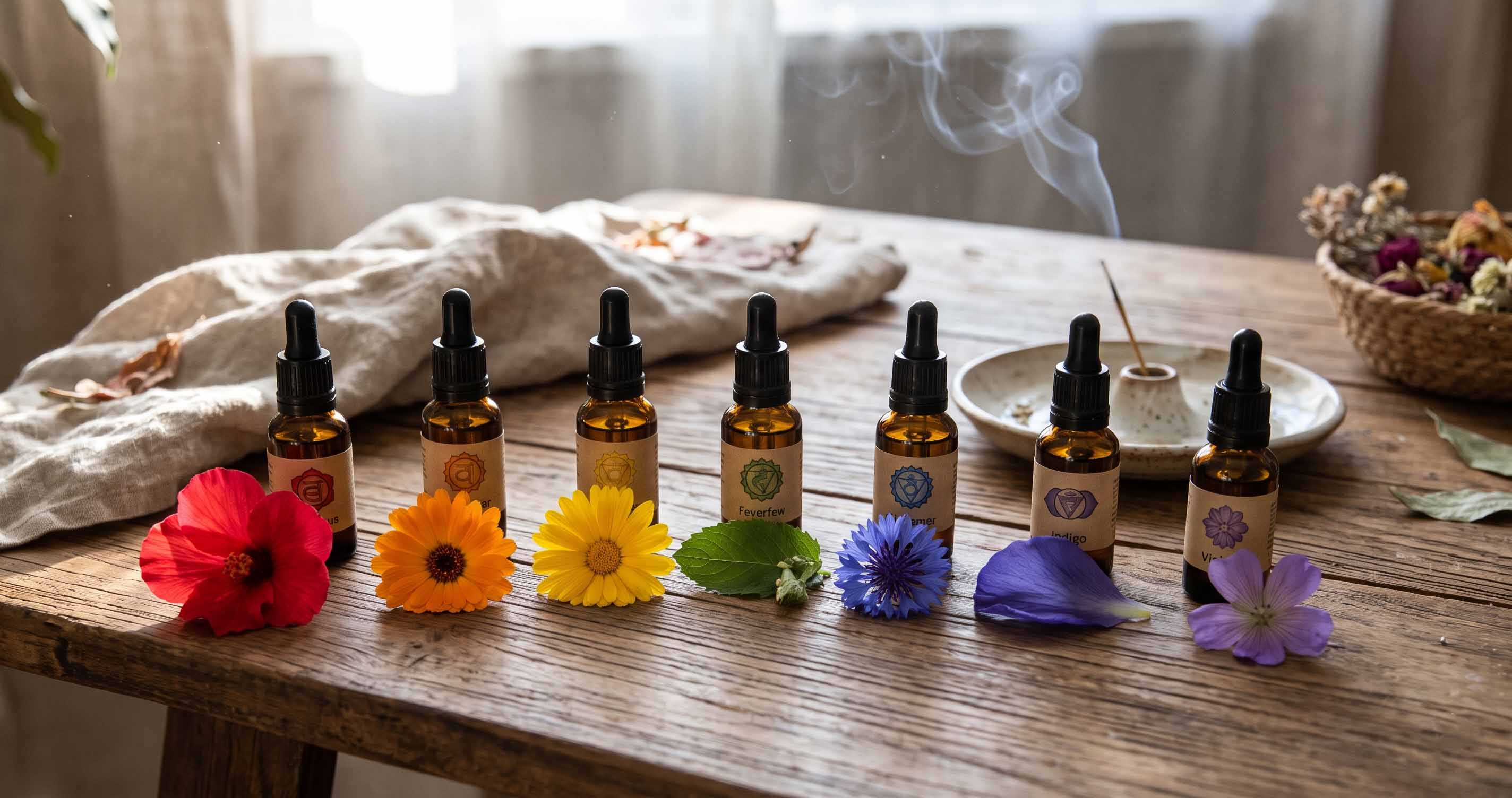
An aromatherapy chakra guide works best when it stays simple: one oil per chakra, seven scents in total, each used as a small cue for attention. Pair a single aroma with a single centre and its petals, and you have a daily practice you can actually remember, instead of a shelf of bottles you never open.
Dr S Pujah works with clients in person in Al Barsha, Dubai, and online across Abu Dhabi, the GCC and Singapore.
I am often asked which oils "belong" to which chakra. My honest answer is that these are traditions and associations, not fixed laws. Different teachers pair them differently. What matters is that you choose one scent, stay with it, and let it become a familiar doorway into a few quiet minutes with yourself.
Why one oil per chakra is enough
When people first discover aromatherapy, they tend to collect. Three oils for the root, four for the heart, a complicated blend for the crown. Within a month the practice has become a storage problem.
Scent works through association. The more often you meet the same aroma in the same quiet moment, the faster that aroma brings you back to that moment. One oil, repeated, builds a clear association. Five oils, rotated, build a pleasant blur.
So in this guide I keep to a strict rule: a single oil for a single chakra. If you love a different oil for a given centre, swap it in. Just keep it to one.
How the petals fit into the practice
In the yogic tradition each chakra is pictured as a lotus with a specific number of petals. I find the petals wonderfully practical, because they give the mind something to count while the scent gives the senses something to rest on.
- Root: four petals
- Sacral: six petals
- Solar plexus: ten petals
- Heart: twelve petals
- Throat: sixteen petals
- Third eye: two petals
- Crown: the thousand-petalled lotus
You do not need to believe anything in particular to use this. See the petals as a symbolic map, a way of giving shape to seven different qualities of attention: steadiness, enjoyment, will, warmth, expression, insight and stillness.
The aromatherapy chakra guide: seven oils, seven centres
Here is the pairing I suggest as a starting point. Each is a widely used traditional association, chosen because the oils are easy to find in the UAE and most other places.
Root: cedarwood
Woody, dry and low. Cedarwood smells like something with roots, which is exactly the image you want for the four-petalled lotus at the base of the spine. Use it when you want to feel settled in your seat before the day begins.
Sacral: sweet orange
Bright, juicy and uncomplicated. The sacral centre is linked with enjoyment and creative flow, and sweet orange is the scent most people smile at without thinking. Six petals, six slow breaths.
Solar plexus: lemon
Sharp and clean. The ten-petalled lotus is associated with will and direction. I like lemon here because it has an edge to it; it suits the moment when you decide what today is really for.
Heart: rose geranium
Soft, green and floral. True rose oil is precious and costly, so rose geranium is the practical choice for a daily routine. Twelve petals, and a moment to think of someone you appreciate.
Throat: peppermint
Cool and clear. The throat centre, with its sixteen petals, is about honest expression. A brief breath of peppermint before a difficult conversation is a small ritual of preparing your words.
Third eye: lavender
Calm and familiar. Two petals only, so this is the simplest count of all. Lavender suits the quiet, inward look of the brow centre and works well at the end of the day.
Crown: frankincense
Resinous and spacious. Frankincense has been burned in places of prayer across this region for a very long time, and its scent carries that sense of stillness. For the thousand-petalled lotus you do not count; you simply sit.
A five-minute petal practice with one oil
This is the routine I return to. It needs one bottle, a tissue or a diffuser, and five minutes.
- Choose today's centre. Work through the week from root to crown, one chakra per day, or stay with one for a whole week.
- Prepare the scent. Put one drop on a tissue, or a few drops in a diffuser with water. Keep the bottle away from your skin and eyes.
- Sit and place your attention. Bring your awareness to the area of the body linked with that chakra.
- Count the petals. Breathe in the aroma gently and count one slow breath for each petal. Four for the root, six for the sacral, and so on. For the throat, sixteen breaths is a lovely length of sitting.
- Ask one question. Root: where do I feel steady today? Sacral: what would I enjoy? Solar plexus: what matters most? Heart: whom do I appreciate? Throat: what needs saying? Third eye: what am I not seeing? Crown: can I simply be here?
- Write one line. A single sentence in a notebook is enough. Over weeks, these lines become a record of your own patterns.
That is the whole practice. It is a routine of attention and reflection, nothing more mysterious than that, and its value comes from repetition.
Using essential oils sensibly
Essential oils are concentrated, so a little care goes a long way.
- Use them for scent: on a tissue, in a diffuser, or properly diluted in a carrier oil. Do not swallow them.
- Never apply undiluted oil to the skin, and try a small patch first with any diluted blend.
- Citrus oils such as lemon and sweet orange should not be worn on skin that will be in strong sun, which matters a great deal in Dubai.
- Keep bottles away from children and pets, and ventilate the room when diffusing.
- If you are pregnant, have sensitive skin or any health concern, check with your doctor first. This practice is not a substitute for advice from your doctor.
Buy from a supplier who names the plant and its origin on the label. In our climate, store bottles in a cool, dark cupboard; heat and light flatten a scent quickly.
Common mistakes with scent and chakras
Chasing the "correct" oil. There is no universal chart. If frankincense feels like a heart scent to you, let it be your heart scent. Consistency matters more than convention.
Using too much. A room thick with fragrance is tiring. One drop on a tissue is often better than a diffuser running all morning.
Skipping the petals. Without the count and the question, you are simply enjoying a nice smell. Pleasant, but not a practice. The petals give the scent a job to do.
Expecting the oil to do the work. The oil is a bell that calls your attention. What you notice once you are paying attention is entirely yours.
Going deeper into the seven chakras and their petals
One oil per chakra is a beginning. Each petal in the traditional map carries its own symbolism, and there is a great deal to explore once the simple routine has become a habit. I have written about the chakras and their petals at length, because I believe this old map deserves unhurried study, one centre at a time.
Dr S Pujah is available in person in Al Barsha, Dubai, and online for readers in Abu Dhabi, the GCC and Singapore.
If this practice speaks to you, your next step is to browse my books on the seven chakras and their petals and choose the one that matches where you are right now. Start with a single bottle, a single chakra and a single page, and let the practice grow from there.
Frequently asked questions
Which essential oil goes with which chakra?
There is no single official chart; pairings vary between teachers and traditions. A simple starting set is cedarwood for the root, sweet orange for the sacral, lemon for the solar plexus, rose geranium for the heart, peppermint for the throat, lavender for the third eye and frankincense for the crown. Choose one per centre and stay consistent.
Do I need all seven oils to begin?
No. One bottle is plenty to begin with. Pick the chakra whose quality you most want to give attention to this month, choose its oil, and practise the petal count with that scent for a few weeks. You can add the next oil once the first routine feels natural and has become part of your day.
Can I apply chakra oils directly to my skin?
Essential oils should not be used undiluted on the skin. For this practice, scent alone is enough: a drop on a tissue or a few drops in a diffuser. If you prefer to wear a scent, dilute it properly in a carrier oil, try a small patch first, and avoid citrus oils on skin exposed to strong sun.