Books
Awakening the Seven Chakras in Children: A Parent's Guide
Dr S Pujah · 27 November 2026
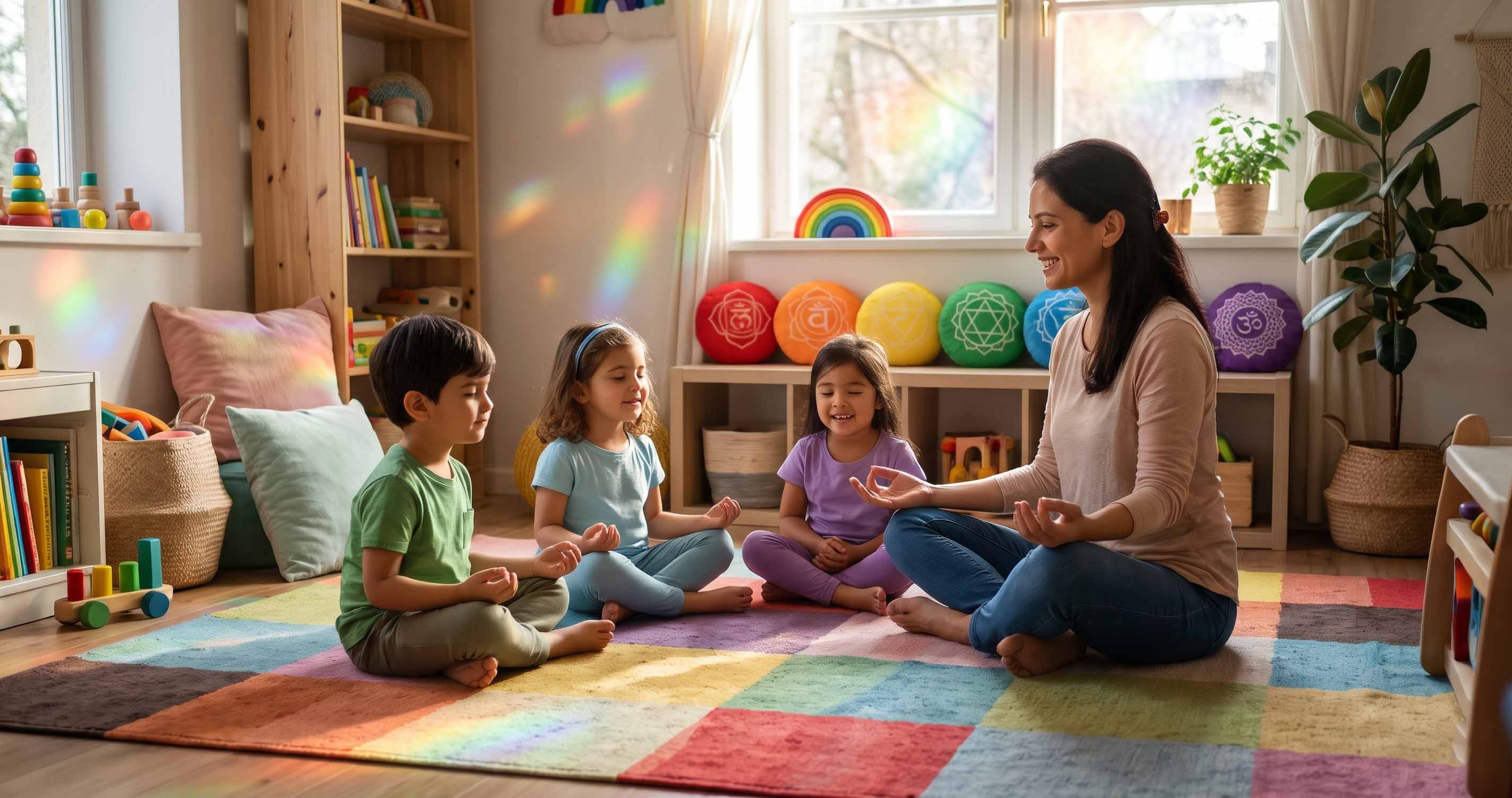
Awakening the seven chakras in children simply means giving a child easy words, colours and small routines for noticing how they feel, from feeling steady to feeling heard. A good chakra book for children does this through story and play, and a parent's role is to read alongside, stay curious and keep it light.
Dr S Pujah works with families in person in Al Barsha, Dubai, and online across Abu Dhabi, the GCC and Singapore.
What "awakening" really means for a child
When parents first ask me about this, many imagine something elaborate: long meditations, special rooms, a child sitting perfectly still. That is not what I mean, and it is not what children need.
In the yogic tradition, the seven chakras are described as seven centres along the body, each linked with a colour, a theme and a lotus with a certain number of petals. For a child, I use them as a picture language. Seven colours, seven simple ideas, seven ways of asking "how am I today?"
So awakening, in a family home, is closer to waking up attention. A child who can say "my tummy feels wobbly before school" or "my throat feels tight when I want to say something" already has a vocabulary many adults never learned. The chakras give that vocabulary a shape and a colour, which children love.
The seven chakras in a child's language
Here is how I introduce each centre to young readers. Notice that every line is about an everyday feeling, not a mystical idea.
- Root, red: "I am safe. I have a home, a bed and people who look after me."
- Sacral, orange: "I can play, make things and enjoy them."
- Solar plexus, yellow: "I can try. I can do hard things one step at a time."
- Heart, green: "I can be kind to others and to myself."
- Throat, blue: "I can say what is true for me, and I can listen."
- Third eye, indigo: "I can imagine, wonder and notice."
- Crown, violet: "I am part of something bigger: my family, nature, the sky."
You do not need to teach all seven at once. One colour a week is plenty, and it gives a child time to live with each idea before the next one arrives.
What to look for in a chakra book for children
Not every book on this subject is written with a child's pace in mind. Some are adult books with brighter covers. When you are choosing a chakra book for children, I would look for these qualities.
- Story before theory. Children remember a character who feels shy and finds her voice far longer than they remember a definition of the throat chakra.
- One idea per page or chapter. A single colour, a single theme, a single small activity.
- Something to do. Colouring, drawing, a breath to try, a question to answer. Children learn through their hands.
- Honest, gentle language. The book should present chakras as a tradition and a way of reflecting, not as magic that fixes problems.
- Room for the parent. Prompts or questions that invite you into the conversation, so the book becomes shared time and not homework.
- Respect for every family. Families of many cultures and beliefs live side by side here in the UAE. A good book offers the chakras as symbols anyone can explore, without asking a child to believe anything in particular.
Age matters too. A four-year-old mostly wants colours and pictures. An eight-year-old enjoys the idea of petals and can count them. A twelve-year-old may want to journal privately. Choose for the child in front of you, not for the child you expect in three years.
The petals: a detail children love
In the traditional picture, each chakra is drawn as a lotus with its own number of petals: four at the root, six at the sacral centre, ten at the solar plexus, twelve at the heart, sixteen at the throat, two at the third eye and the thousand-petalled lotus at the crown.
Adults often skip this part. Children do the opposite. They count the petals, draw them, and ask why the heart has twelve. I use the petals as a drawing exercise and a doorway to reflection. If the heart has twelve petals, can we think of twelve people, animals or places we care about and write one on each? If the root has four, what are four things that help us feel at home?
There is no test and no wrong answer. The petals simply slow a child down long enough to think.
How to read together: a simple weekly rhythm
Children respond to rhythm far more than to intensity. Ten calm minutes, repeated, will do more than one ambitious afternoon. This is the pattern I suggest to parents.
- Pick a regular slot. Bedtime works for many families. A quiet weekend morning works for others.
- Read one chakra only. Close the book when the section ends, even if your child asks for more. Wanting more is a good sign.
- Ask one open question. "When did you feel brave this week?" for yellow, or "Who did you feel close to today?" for green.
- Do one small activity. A drawing, three slow breaths with a hand on the tummy, or finding five things of that colour around the house.
- Share your own answer. Children open up when the adult goes first. Tell them when you felt unsure, or what helped you speak up.
After seven weeks you will have travelled through all seven colours. Most families then begin again, and the second round is usually richer, because the child now arrives with their own examples.
Everyday moments that bring the pages to life
The book is only the starting point. The real learning happens in ordinary family life, when you connect a colour to something your child is already doing.
- Barefoot time on the beach or in the park becomes a red, root moment: feet on the ground, noticing what is solid.
- Painting, baking or building with blocks is orange: making for the joy of it.
- Tying shoelaces alone or finishing a hard puzzle is yellow.
- Making a card for a grandparent overseas is green.
- Singing in the car, or practising how to ask a teacher for help, is blue.
- Cloud watching and bedtime stories are indigo.
- A quiet minute looking at the night sky in the desert is violet.
You do not have to name the chakra every time. An occasional "that was a very yellow thing you just did" is enough to make a child smile and remember.
What to avoid as a parent
A few gentle cautions, from years of watching what works and what does not.
- Do not label your child. Saying "your throat chakra is blocked" turns a playful picture into a judgement. Ask a question instead.
- Do not insist on sitting still. Young children reflect while moving, drawing and talking. Sitting silently is a skill that grows slowly.
- Do not use it as discipline. The colours are for understanding feelings, never for correcting behaviour.
- Do not promise results. This is a reflective practice and a family ritual. It sits alongside good sleep, play, school and the advice of the professionals who care for your child, and it does not replace any of them.
- Do not rush. If your child loves green and wants to stay there for a month, stay.
Start with one colour this week
If this is new to your family, begin small. Choose one colour, read one short section, ask one question and listen properly to the answer. That is the whole practice, and it is enough.
Families in Al Barsha, Dubai, can meet Dr S Pujah in person; families in Abu Dhabi, the GCC and Singapore work with her online.
My own writing on the seven chakras and their petals grew out of exactly these conversations with parents and children. If you would like a companion for your reading time, you are warmly invited to browse my books on the seven chakras and choose the one that suits your child's age and your family's pace.
Frequently asked questions
At what age can children start learning about chakras?
Most children can enjoy the colours and simple themes from around four or five, when they like naming feelings and drawing. Keep it to pictures, colours and one easy question. Older children, from about eight, often enjoy counting the petals and keeping a small journal. Follow your child's interest instead of a fixed schedule.
Do I need to know about chakras myself before reading with my child?
No. You can learn alongside your child, and many parents find that is the nicest way. Read one section ahead if it helps you feel prepared, then explore it together. Children do not need an expert. They need an adult who is curious, listens to their answers and shares a few honest ones too.
Is learning about chakras a religious practice for children?
The chakras come from the yogic tradition, and families relate to them in different ways. In my work with children I present them as symbols: seven colours and themes for noticing feelings, kindness, courage and wonder. You can explore them as a reflective family activity alongside your own beliefs, and adapt the language to suit your home.